Welcome

Welcome to The Great Dharma.

If this is your visit, please read this introductory post and then the ‘How to Read this Blog’ page above.

The central theme of this website is that, given the ‘perfect storm’ of existential threats that could confront humanity during rest of the 21st Century, it will be like no other period in recorded human history. If we are to avoid a series of catastrophes, each potentially being a holocaust of innocent suffering on an unimaginable scale, sooner or later humankind will need to undergo a spiritual renaissance.

Human beings can rise to their best when most threatened. But, as each nation or religious group vies for power or to maximise its share of the Earth’s ever diminishing resources, many of the direst threats could fatally divide us; and, divided, we most certainly will fall. Only an inspiring vision of how the full potential of human life on this Earth could be for each of us as part of global civilization can unite us and help to ensure that human life flourishes on an Earth itself still flourishing with abundant life.

Such a vision of human potential will require a spiritual revolution that will necessarily be both humanistic and ecological. To put it bluntly, when catastrophe threatens there will be no personal, loving God to save us. Only human intelligence, love and compassion and a willingness to unite can do that.

Read more of this post

Music and Devotion

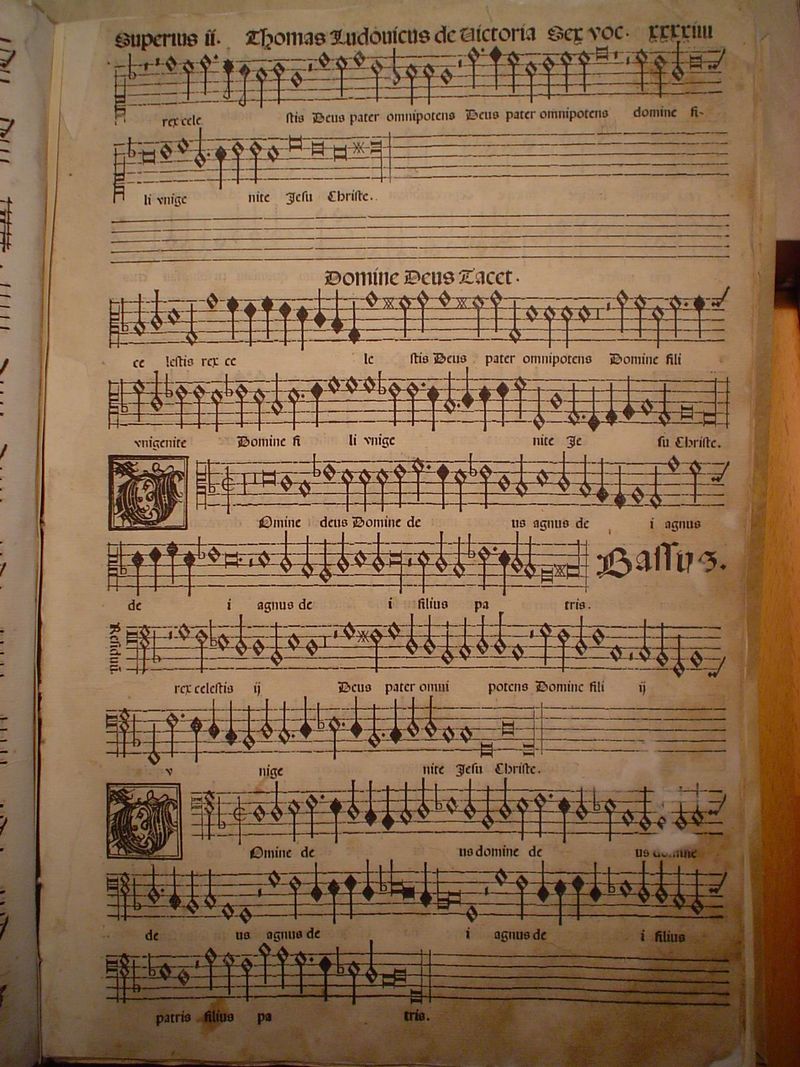
Score by Tomás Luis de Victoria

Please excuse the pun, but, increasingly, I’m finding the devotional music of the late Renaissance a serene counterpoint to the, at times, overly insistently dynamic and goal-oriented music of my guru, Beethoven. There are times when you just want music to wash over you; to carry you away; to allow yourself to be lost in the sweet and earnest beauty of its ceaselessly interweaving counterpoint.

I am vaguely familiar with only very little of this music. I am aware of just a few works of the more famous composers of this period: the Missa Pape Marcelli by Palestrina, the marvellous forty-part motet, Spem in Alium by the Tudor master of polyphony, Thomas Tallis, which at times creates a ‘wall of sound’ far move overwhelming that anything created by Phil Spector in the 1960s. One candidate for the current pop classic of this period is Allegri’s Miserere from around 1630. I love the televised version of this piece by Harry Christophers and the Sixteen, where the boy soprano is replaced by a female soprano in singing the soaring high notes, culminating in the famous top Cs. This music is hauntingly beautiful.

For anyone who is not a devout Catholic the words of much of this music can be very hard to connect with. A common theme seems to be self-abasement, verging on self-loathing, before God: “And my sin is ever before me… Against You only have I sinned and done evil in Your sight… Behold, I was brought forth in iniquity and in sin did my mother conceived me.” I find some of these sentiments obnoxious; all the more so since I believe that the most insidious effect of Roman Catholicism is to exercise its hold on the faithful by instilling in them an overpowering sense of sin from which only the Church can offer salvation from eternal torment. To me, this abuse of power is nothing short of an evil in itself (Darwin thought this to be a “damnable doctrine”).

So, how are we to respond to this music? For the most part, I like most others I suspect, have hitherto just ignore the words as I allow myself to be lost in its ethereal beauty.

However, I found a recent BBC4 programme on the Spanish 16th Century composer, Tomás Luis de Victoria (sometimes called da Vittoria), has had quite a profound impact on me; not only by providing me with an approach I might take when listening to the music of this period, but also by giving me a glimpse of what is missing from my own spiritual life, devoid as it is of any notion of a personal god.

Victoria was an ordained priest and seems to be a genuine mystic, someone who devoted himself as a man, as well as a musician, to a heart-felt contemplation of the divine. Such was his personal commitment to his spiritual calling that his music, which is less cerebrally contrapuntal than that some of his predecessors, such as Palestrina, has a direct impact on the listeners’ emotions, directly communicating his own very personal feelings of devotion, especially, to the Virgin Mary and to the story of Christ’s Passion. Much of Victoria’s music also has an ecstatic quality; in this he probably took as his example his early spiritual mentor, Teresa (later Saint Theresa) of Ávila, who was the subject of Bernini’s famous sculpture the Ecstasy of St Teresa.

I’ve concluded that the best way for me to listen to this music of this period is neither to ponder the literal meaning of the words, nor to just to let the music wash over me, inducing a mindless sense of calm. I feel there is far more to gained by engaging imaginatively in the experience that it seeks to communicate: a devotion to the highest and most beautiful ideal that can be conceived, and in so doing, to try to empty myself of all sense of self and will – a fundamental spiritual practice in its own right.

I am therefore left to ponder how we might incorporate into a non-theistic spirituality of the Global Age practices that engender contemplations of equivalent beauty and spiritual power. The Buddhist tradition is very rich in meditative practices that have developed over many centuries since the Buddha’s time, such as the Brahmaviharas – the sublime abodes, as taught by the Buddha himself, and the much later Tonglen practice. Wonderful and essential as some of the traditional practices are, my feeling is that they are not complete. Essential elements of a new spirituality would be a sense of awe and wonder at being an integral part of creation and a love for the World and a devotion to its further blossoming. For me, these explicit sentiments are completely missing from Buddhism.  I therefore hope that new meditative practices will emerge that tap into the capacity that virtually everyone has (sadly, perhaps not most psychopaths) to experience what might be called the divine (our Buddha Nature as its called in Mahayana Buddhism) and in so doing, to find a devotion to a calling to bring love, beauty, joy, understanding and compassion into the World.

The limitations of the Buddha’s Dharma

I believe that the worldview of ancient India at the time that Buddhism, Hinduism and Jainism emerged is, in some crucial respects, incompatible with a world-centred spirituality that will be so crucial to the survival and future flourish of the human race in the 21st Century.

To be completed soon.

The Buddha

The Buddha probably lives around 2,500 ago.

To be completed soon.

J.S. Bach’s Chaconne

The last movement of Bach‘s Partita for Solo Violin in D Minor is the famous Chaconne, surely the work of a musical superman.

I will complete this post soon.

Beethoven’s Pastoral Symphony

Beethoven in 1818 by August Klöber

Image via Wikipedia

I have always thought that the Pastoral Symphony in F Major (No6) is a very special piece of music, even for Beethoven.

One could dismiss this symphony as music from a bygone age, ostensibly depicting a rural idyll from a time when Beethoven’s Vienna of the first decade of the 19th Century was hardly aware of the industrial age that was being born in Britain at that time.

In the 20th Century modern consciousness seemed to be primarily concerned with the urban and the industrial. But, in what is sometimes called the post-industrial age, there is a much wider understanding of our dependance upon a global eco-system that comprises all living things. Our modern conciousness is now imbued with a sense of anxiety about the damage we’re inflicting upon the natural world and a renewed sense of its wonder and fragility. Until we are superseded by intelligent machines or human-machine hybrids we should be more than happy to consider ourselves to be works of nature. That being so, this symphony celebrates one great man’s response to the fundamental nature of our being – that we are a part of the greatest miracle in the known Universe: the living Earth.

The symphony is in five movements, rather than the usual four and, uniquely for a Beethoven Symphony, has as a programme, although he was at pains to stress that the  symphony is “more the expression of feeling than of painting”. Beethoven described the five movements as follows:

1. Awakening of cheerful feelings upon arrival in the country: When Beethoven’s rather fast tempo markings are followed this movement has a somewhat jaunty air. The music contains several short motifs that are continuously repeated and interwoven, conveying the sense of nature continually burgeoning and blossoming. The movement culminates in a deep sense of contentment.

2. Scene by the brook:Beethoven’s most beautiful orchestration and one of his most serene and sublimely joyful pieces.(in 2 parts on YouTube: Part1 & Part2)

3. Happy gathering of country folkA scherzo, an energetic country dance, rather than a minuet; we are with ordinary folk rather than at court with the aristocracy.

4. Thunderstorm Storm: Depicting a storm of ferocious intensity, the music also convey’s a sense of awe, terror and exhilaration at the power of nature.

5.  Shepherds’ song; cheerful and thankful feelings after the storm: The song is a hymn of ever swelling joy and thanksgiving.

The transition from the fourth to the fifth movement, as the last rumbles of the receding storm fade away is magical. One can imagine the return from darkness and fear to the light as the sun comes out to reveal the world, refreshed by rain, glowing with renewed life. These few bars, featuring the oboes, seem to me to faintly echo the old German hymn “O Haupt voll Blut und Wunden” (Oh Sacred Head, Now Wounded), which Bach arranged several times, most movingly as the Passion Chorale in his St Mathhew Passion. If I am right, for a german speaking audience this would subliminally set a sacred tone, perhaps hinting at the thunderstorm during Christ’s Passion, except that here the storm has abated and the rebirth of the world is at hand. The transition culminates in the clarinet followed by the french horn announcing in embryonic form Beethoven’s hymn of joy and thanksgiving (and resurrection?). Its first full flowering is then given life by the strings.

It is pointless to try to convey in words the overwhelming joy that this movement conveys. Beethoven’s control of our yearning for joy is masterful. Towards the end of the movement the music rises to a false crescendo; we are taken to a new heights as the momentum builds again, so that when the true crescendo at last unfolds the listener is filled to overflowing with what might be called religious ecstasy.

I can think of no other piece of music before Beethoven’s time, apart from Bach’s Chaccone for solo violin, that conveys such overwhelming ecstasy of being. It has lead me to wonder if it could be seen as a precursor to the Liebestod in Wagner’s Tristan und Isolde.

If this symphony evokes a religious response, what, one might ask, is the religion? On one level Beethoven was a devout Christian and and it would be perfectly reasonable for Christians to view this music as a hymn of thanksgiving to the Christian God. But Beethoven’s spirituality was, I believe, highly personal and indicative of a time when the old religious certainties were breaking down. He was undoubtedly devout, but he was a Catholic who hardly, if ever, attended mass or confession – something of a contradiction in terms. He had quotations from the Hindu Upanishads on his desk. His great Missa Solemnis might be been seen as a highly personal depiction of the human meeting the divine. His conversation books (his deafness progressed to completeness from his mid-late twenties onwards) seem to imply that music stemmed from a source of divine inspiration that was a force unto itself and, I would say, therefore not ultimately dependant on any particular religious doctrine.

At times a difficult and even an impossible man, Beethoven devoted his life to using his powers as a creator to scale the heights and plum the depths of human experience in order to reveal the majesty of existence that he had glimpsed. It is for this reason that Ludwig van Beethoven will always be my guru.

Postscript

During the the BBC Radio 3 programme ‘CD Review’ of Saturday 5th November 2011 the music critic Professor John Deathridge surveyed the available recordings of Beethoven’s Pastoral Symphony and recommended the version taken from a live performance by the Bavarian State Orchestra (Bayerisches Staatsorchester) conducted by Carlos Kleiber (ORFEO C600031B (CD, mid-price)). The movements listed above link to this recording, which has been posted on YouTube in separate parts.

Professor Deathridge said this version won his selection ‘hands down’. He commended Kleiber’s loyalty to Beethoven’s fast tempo markings and he praised Kleiber for allowing in the last movement the music to unfold as an expression of religious ecstasy with an intensity that was almost heart-breaking. In turning the theatrical into the theological the performance became an event that left the audience stunned. Professor Deathridge concluded that the symphony is a deeply human document and a superb masterpiece.

It seems that many believe that Carlos Klieber (not to be confused with his father, Erich) was the greatest conductor of modern times. His mystique is enhanced because, before he died in 2004 at the age of 74, he performed fewer concerts and recordings than most leading conductors would do in a couple years.

Morning glory

Autumn.

Early morning sunlight playing on a woodland pool.

The greens and browns of the overhanging trees, their leaves turning russet and gold, ring out radiantly, scattering their reflections across the silky, dark water.

Two ducks begin to frolic and suddenly a broad, cascading arc of wavelets ripple outwards; the sunlight and a thousand reflections dance on each of them as they advance towards me.

I feel that they will envelop me in the radiant glory of this moment.

Credo

Now in my sixties, each time I get into bed at night I’m aware of a background feeling of dread. Yet another day has passed all too quickly; I have a very real sense of hurtling through time towards death. I have no illusions that death is anything other than the absolute extinction of consciousness. Whilst I fear the process of dying, the thought of personal extinction does not appal me, at least whilst its not an imminent threat. I do fear that it will come all too quickly, especially since I feel that I have nowhere near achieved my potential. Life is sweet and I would not want to leave my wife and family whilst I am still able enjoy life with them. But far greater than my fear of extinction is my fear that just ahead of me might lie years of physical and mental incapacity and dependence. That seems to me to be the ultimate degradation of what life should be.

Yet I have faith, or perhaps just hope, that it is possible, whilst we are still engaged in the midst of life, to achieve a radiance of being from which joy, meaning and purpose can flow. Such a radiance of being would enable us to live creative and compassionate lives in communion with others and in a way that deepens our resilience in the face of the worst that might confront us. My hope is that if the worst happened and I became completely helpless, even unable to speak, I would still be an inspiration to those supporting me, because such radiance would still be evident, if only through a gleam in the eye or a squeeze of the hand. Perhaps my last gift would be my need for their compassion, which would ennoble them. So, perhaps, the prime goal of life ought to be to achieve such radiance, so that one’s life is transformed for the benefit of oneself, others and the World.

But how might such radiance be achieved? The mystics and seers of the World’s great religions tell us that a profound serenity, even bliss, can be achieved through deep and sustained meditation or prayer, the purpose of which is to focus our attention onto what is most fundamental about existence in that moment. It is said that in such moments one achieves a state of consciousness freed the ego-centric realms of fantasy or of a distortedly remembered past or imagined future. It is commonly reported that when the ego is overcome it can be replaced by what William James, the American philosopher called ‘cosmic consciousness’ – a sense of not being a separate entity observing the rest of reality, but of being an integral and inseparable part of all that is.

Too often it seems those who claim to have achieved such a spiritual breakthrough are in the World but not of the World. I live in hope that it is possible to achieve a radiance of being that is intimately connected to the stream of daily life of ordinary people, with all its joys, sorrows, struggles, failures and achievements. People need to a find meaning and purpose in life that is greater than themselves – something that both ennobles each life and outlives it. If, as I believe, the quest for an eternal life is both self-defeating and negation of what is most important in human life, the only entity worthy of our love and devotion that far outlives us is the World itself: the miraculous physical, ecological, cultural and social environment that gave birth to each of us and that will bear our legacy into the future. My hope, therefore, is that there is a way to live my life as a radiant and compassionate gift to the World, which is the realm of humanity’s shared existence, hopefully for millennia yet to come.

The possibility of a spiritual epiphany without God

It seems that a common aspiration in all spiritual traditions is self-transcendence. This is hardly surprising since much of religious doctrine is aimed motivating the individual to abandon self-centeredness as a moral imperative and to follow the paramount requirement to submit oneself to God. However, its clear from every spiritual tradition that some intense self-transcending practices can lead to what might be termed mystical or world-transcending experiences that provide, if only temporarily, a deep sense peace and joy and connection with the rest of creation.

Practices vary widely across all the great spiritual traditions and can involve, amongst many others, intense periods selfless prayer, group incantation, quiet meditative contemplation or even, in the case of Sufi Islam, swaying and whirling. What seems to be common is a relaxed form of deep concentration in which the sense of self, which is always most concrete when pondering the past or an imagined future, is temporarily suspended. At such times there is an acute but calm awareness, but not from the standpoint of the self, with its time-bounded obsessions of likes, dislikes, regrets, hopes and fears.

When the sense of self is overcome it is often replaced by what William James, the American philosopher called ‘cosmic consciousness’ – a sense of not being a separate entity observing the rest of reality, but of being an integral and inseparable part of all that is. There may well be physiological reasons why humans are capable of such experiences. In her well-known talk at one of the TED conferences, the neurophysiologist, Jill Bolte Taylor relates a powerful experience that she had when she suffered a huge stroke in the left hemisphere of her brain. Between periods of panic, during which she tried to overcome her impaired language and motor control in order to phone for help, she had experiences of great joy and expansiveness. During these periods she felt her body to be without boundaries and herself connected in a free exchange of energy with the whole of the rest of reality. This she attributes this experience to the suspension of those seemingly left-hemisphere functions that define our physical boundary and our sense of self as being locked in a continuum of time between past and future. Other neurological researches into mystical experiences seem to confirm that that there are indeed areas of the brain that control our sense of our body’s physical boundary and its place in space and when these are ‘switched off’ such powerful experiences can occur. Since, I take it as axiomatic that all mental processes are underpinned by physiological processes within the embodied brain (this, in my view, does not entail reductionism), I don’t think that physiological explanations of how such experiences might occur invalidate them. We know that some people taking ‘psychedelic’ drugs, such as LSD, have reported similar experiences. The point is that such experiences are very powerful, even transformative, and allow insights into the nature of existence that may well be just as valid as those everyday experiences more usually dominated by an overriding sense of a bounded, separate self navigating between past and future. Like any other experience of the world, the elapse of time, which is such a fundamental and yet such an utterly mysterious aspect of normal consciousness, is a brain-mediated. If it attenuated in any way this must lead to a profoundly different experience of reality.

Unfortunately, I have never had such a life-changing experience myself; at least not to the degree I believe some have genuinely experienced. Like almost everyone else, I have had moments of uplifting joy and, perhaps, fleeting moments of insight, usually when out walking and opening up to the beauty of the natural world or when listening to great music. A number of times I have had a delicious sensation of a lightness of being after spending a 45 minute train journey to London in a semi-meditative state cultivating goodwill towards my fellow passengers. However, I cannot claim that any of these individual experiences, all of which quickly faded, have been profoundly life changing. But I take it on trust that such epiphanies are possible and that it should be an essential part of any spiritual path to follow practices that open oneself up to the possibility of such transformative experiences occurring.

I also take it on trust that such spiritual illumination is possible without necessarily attaining sainthood or achieving perfect enlightenment in the Buddhist sense. I’m happy to be agnostic about how far any individual can approach a completely transformed state, let alone perfection, however that may be defined. But profound experiences that are blissful and that open one up to new dimensions of reality seem to be both attainable and highly desirable. However, from what I have learned in Buddhism, the pursuit of spiritual illumination as an end in itself may well be self-defeating, especially if such a quest were mainly self-serving. It seems that spiritual illumination is more likely to occur as a by-product, if we assiduously follow practices that engender selflessness, love, compassion, peace and acceptance for their own sake.

The core of any profound experience is ineffable – it that cannot be adequately explained in conceptual terms, which is perhaps why some of the very greatest artists have sought to convey their essence through the poetic and metaphorical language of the arts. However, given that such experiences are so powerful, its natural that people should want to communicate their impact and significance. This it seems to me is where the danger lies, because hitherto most attempts to explain such experiences have entailed using conceptual language drawn from the individual’s religious worldview. In so doing, they are drawn into making claims about the nature of the shared universe that can’t be justified in rational terms. Experiences of ‘cosmic consciousness’ might be explained as union with Christ, God or Allah or the liberation from the rounds of earthly rebirth or reincarnation or some other access to eternal life. Most of these claims must be mutually exclusive and so, if we’re not careful, we can slide back into the destructive cycle where our highest spiritual aspirations lead us to make exclusive claims of certainty about the world that cannot be verified and can lead to disunity at best and global conflict at worst.

The great challenge for the humanistic spirituality that the world so desperately needs as it enters the Global Age, is to discover a great new spiritual vision (a great dharma, to use a Buddhist term), partly inspired by the awesome panorama provided by science, of humanity’s place in nature. Such a dharma would allow us to see a connection between moments of epiphany and our everyday lives, without the need for unverifiable claims, but in a way that enlarges our capacity to live our lives joyfully and compassionately as gift to all beings and to this world, which is the realm of humanity’s shared existence, hopefully for millennia yet to come.

The Buddha pointing at the Moon

There is a legend that Buddha likened his teaching, his Dharma, to a finger point at the Moon, which, in this analogy, represents the ultimate truth that can only be apprehended by experience and can never directly communicated in human language. He also liked his teaching to a raft that could ferry you across the river of greed, hatred and delusion. As he said, once over the river you would cast the raft aside, you wouldn’t carry it further, once it was of no further use to you.

This tells us that the Buddha perceived an ineffable truth about human existence in this World and that his teachings shouldn’t be confused with ultimate truth itself. In modern parlance, we might say that this truth must be written in the stars: it must be part of the fabric of our Universe. It asserts that human life, although it has come about over billions of years, through the vagaries of cosmic, stellar, geological and biological evolution, is not a purely accidental and meaningless process.

For those who have experienced the joy and freedom that the Buddha’s teaching can bring, it represents one of the great breakthroughs in our understanding of the human predicament (religious Buddhists would, of course, elevate the Buddha’s attainment even higher). For the danasattva, the human pursuit of wisdom is an unending quest to deepen our understanding of the Great Dharma at the mysterious heart of our World, the Buddha’s Dharma being but one great step in that quest.

The serenity and joy of meditation

Imagine a danasattva sitting in deep meditation. His attention becomes focussed. He can now see the figments of the ego flit across his mind and pass away. A delicious lightness of being floods his awareness. Gradually, the burden of egocentric selfhood drops away. He is not ‘blissed out’: his attention is exquisitely poised; universal loving kindness arises. His being is filled with light as his awareness soars and expands so that he feels the boundary between his inner and outer selves and the rest of cosmos dissolve. He sits long with a feeling of deep and quiet joy until he is ready to return to the World with a generosity of spirit that overflows.